
If You Can’t See It, You Can’t Shoot It: One Man’s Quest to Improve His Sporting-Gun Vision
Like many of you, I am constantly looking for ways to improve my shooting. Whether it is reading how-to articles by top pros, taking lessons, or experimenting with new chokes, the quest for shooting perfection never ends. I recently embarked on an odyssey to see if it is possible to improve my eyesight, which in theory would in turn improve my overall shooting.
I have watched enough YouTube videos by renowned sports vision Optometrist Ed Lyons to know that what the eyes do not see the shotgun can’t shoot. However, I have always been confused by the type of exercises I need to do to improve my vision and why. Afterall, I use my eyes all day long so why do I need to exercise them? The short answer is far too many of us (me included) spend too much time staring at computer screens and we do not use our eyes to their fullest.
Sports vision training uses exercises to improve visual skills that matter in shotgun sports: depth perception, eye tracking, reaction time, peripheral awareness, and focus switching.
Google eye training devices and you will be overwhelmed with results ranging from simple and inexpensive to more immersive and expensive.
The simple and inexpensive route includes Fusion Cards, Brock String, and Hart Cards.
Hart cards (often called Hart charts) consist of two grids of letters, a large chart placed on a wall and a smaller version held in the hand. By rapidly shifting your gaze from the large, distant chart to the smaller, closer chart, you actively flex the ciliary muscles inside your eyes. This builds the stamina needed to smoothly transition your focus from far to near.
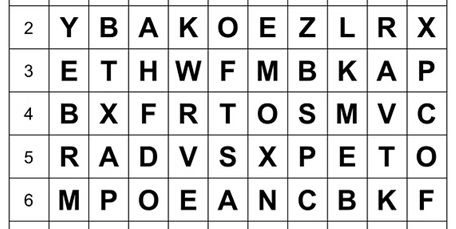
A Hart card.
Fusion cards are visual training tools designed to build eye-teaming, focusing, and depth perception (stereopsis). They work by presenting slightly offset or colored images that force your eyes to deliberately converge or diverge to merge the images into a single, clear, 3D picture.
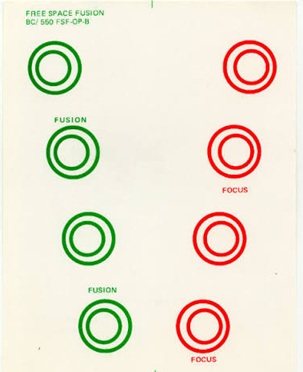
A Fusion card.
The Brock string is used to train the eyes to work together as a team (binocular vision). It consists of a 10- to 15-foot string with three colored beads placed at various distances. You hold one end of the string to the tip of your nose and tie the other end to a fixed object. As you shift your focus between the beads, your eyes are forced to turn inward (converge) and outward (diverge) simultaneously.

A Brock String.
All three are inexpensive and there are several websites with instructions on how to make and print your own Hart Chart and Fusion Cards. I purchased an inexpensive Brock String from Amazon and opted to print my own Hart Chart and Fusion Cards. However, I quickly got bored using all three methods as I found them tedious and they felt like work, so I am glad I didn’t spend much money on them.
After this failed attempt to create a sustainable training routine, I realized that I needed something that was easy to use but kept me engaged and would also allow me to track my progress. Something the three other training methods I tried did not do. Thus, I started to research apps I could use on my iPad or with a Meta Quest VR headset.
Here are the Apps I researched:
Vizual Edge is the most established product in the space and it works on an iPad. They have been around the longest and have built a database of visual performance data. Their “Edge Score” lets athletes see where they rank against others by sport, age, and skill level. Visual Edge uses 3D glasses (red/cyan anaglyph glasses) and browser-based exercises to work the eyes in 3D. They offer 6 exercises with recommended 15-minute sessions, 3 times per week. Pricing is hard to discern as you must schedule an appointment with a sales consultant to discuss your needs. As far as I could learn, an individual subscription starts at $44.00 month (billed annually) or $59.00 on a monthly basis. Visit https://www.vizualedge.com
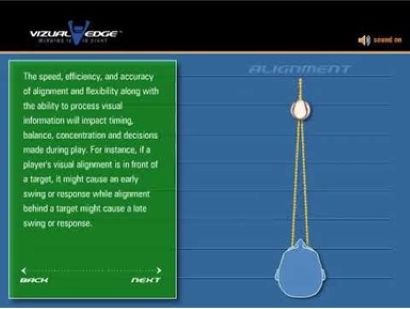
A Vizual Edge screen shot.
Optics Trainer can be used both on an iPad and a VR headset. The platform offers over 28 training exercises for the iPad and over 12 in the VR headset. It trains convergence, divergence, depth perception, eye teaming, and visual memory. It offers both an anaglyph 3D glasses mode within the mobile app and a separate VR version.
However, Optics Trainer is primarily designed for vision therapy and is not marketed as a sports training aid and has no sports specific recommended exercise regimen. The cost is approximately $14.99 a month for the app and $19.99 a month for VR version. Visit https://home.opticstrainer.com
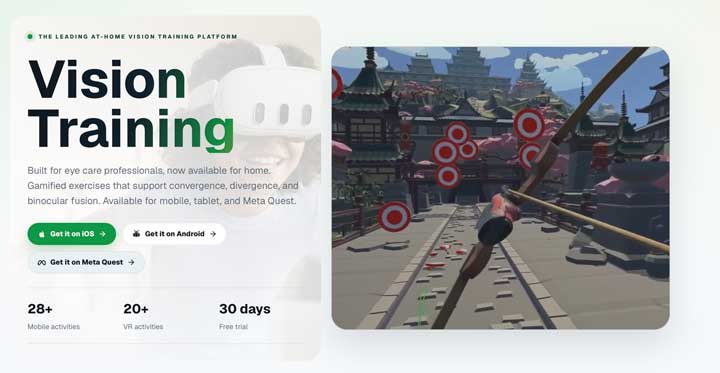
Optics Trainer software.
3D Vision Gym uses the same 3D approach as Visual Edge on an iPad or computer — red/cyan glasses with browser-based exercises — but with more exercise types (9+ including Divergence, Convergence, Jump Ductions, Depth of Field, Smooth Pursuit, Saccadic, Peripheral Awareness, Multi-Object Tracking, and Performance Assessment.
They offer sport-specific training modes with one designed for shotgun shooting sports.
As you probably have guessed from my opting to make my own Hart and Fusion Cards, I am frugal. Thus, I opted to test the 3D Vison Gym. First off, they offer a 14-day free trial that gives you access to the entire site and their monthly subscription rate if you want to continue thereafter is $12.99 a month or a year subscription at $100.00.
After purchasing a $8.00 pair of 3D glasses from Amazon, I downloaded the 3D Vision Gym software from the App store and started my 14-day free trial. The site is intuitive and there are clear instructions on how to calibrate an iPad or computer for use as well as your 3D glasses. Also, all the exercises and how they train your eyes are clearly explained in the how-to guide. Some of the exercises require you to wear 3D glasses while others do not. I found this to be a good balance between the two.
All the exercises allow you to increase the difficulty of the task and also track your progress.
The visual skills that matter for clay shooting—tracking, peripheral awareness, depth perception, focus flexibility, reaction time—are what 3D Vision Gym trains. Visit https://3dvisiongym.com
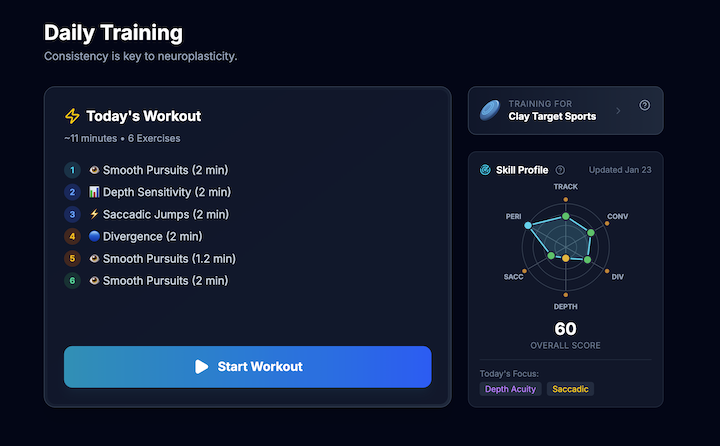
A 3D Vision Gym screen shot.
Tracking exercises build smooth pursuit capabilities. You follow targets at progressively higher speeds and across unpredictable paths, training your eyes to maintain lock without saccadic interruption.
Peripheral awareness drills force you to maintain central focus while detecting and responding to stimuli in your peripheral field.
Vergence and depth perception training refine your binocular vision. Convergence exercises (tracking objects approaching you) and divergence exercises (tracking objects receding) train the eye coordination that underlies distance judgment.
Focus flexibility drills which strengthen the ability to jump between near and far focus points.
Most of the exercises involve tapping on a small circle that appears on screen as the circle either changes size or moves.
For instance, in the peripheral awareness drill you focus on a small square centered in the middle of your iPad screen. Letters appear in the square and you must tap the square when the letter X appears. At the same time, in the outermost four quarters of the screen a yellow circle will randomly appear. You must also tap on that circle to verify that you see it. Focus too intensely on the center square and you will miss what is in your peripheral view. Similarly, if you start to look for the circle in your peripheral view you will miss the X as it randomly appears in the center. The drill is timed at two minutes and I find it to be both challenging and also fun to do. In fact, most of the exercises have a gaming aspect to them and you find yourself trying to beat your last scores. However, as the difficulty increases (targets appearing faster), your scores take a hit.
I have been using the software for about two months now on an average of about four times a week for about 20 minutes at a time. The fact that I have stuck with it is a testament to the gaming aspect of the training. It doesn’t feel like work.
So, has my shooting improved as a result of my eye training? Maybe. I do believe my overall vision has improved and I can honestly say I am picking up targets quicker in my peripheral view especially on crossing targets. But, as we all know, successfully breaking clays involves a lot more than sight. Body position, hold point, gun speed, timing and shot placement all must be in sync. In short, exercising your eyes extensively will not compensate for a lack of talent, coaching and time behind the gun. However, vision accounts for the vast majority of the information received and processed by your brain. Before you can make your move on a clay, your eyes must be actively engaged to prepare your brain and body to execute the shot. So, training your eyes with the key visual skills needed in shotgun sports can only help to improve your overall game when combined with overall training.
The way I look at it is: for the price of a single box of 12-gauge shotgun shells a month, I have the ability to train wherever and whenever; an aspect of the game that is often overlooked.
Malachy Kavanagh is a recreational sporting clay enthusiast who lives in Garrison, New York. He can often be found striving to improve his game practicing at Mid Hudson Sporting Clays in New Paltz, New York.

Malachy Kavanagh is a recreational sporting clay enthusiast who lives in Garrison, New York. He can often be found striving to improve his game practicing at Mid Hudson Sporting Clays in New Paltz, New York.

Comments