
Elon Musk vs. Cajun Duck Hunters
The famous line “Charlie don’t surf” from the movie Apocalypse Now portrays a surreal take on the American military during the Vietnam War of using overpowering force to impose its own logic, sport and cultural supremacy.
It’s delivered by Lieutenant Colonel Bill Kilgore, played by Robert Duvall, who struts shirtless on a beach under siege seemingly immune to the barrage of mortars. An avid surfer, Kilgore orders his men to grab a surfboard from their helicopter and paddle out through the explosions. The line “Charlie don’t surf” expresses his contempt for the Viet Cong forces referred to by American soldiers as “Charlie,” who don’t really appreciate the golden California lifestyle. Kilgore effectively sees the beach as Vietnam’s Surf City USA to be acquired through military force, or more expeditiously a spectacular display of napalm carpet bombing.
For Elon “Mars or Bust” Musk, the announcement by his company SpaceX on August 25, 2026 in Abbeville, Louisiana, featuring SpaceX President SpaceX and Chief Operating Officer Gwynne Shotwell, about the proposed Starbase Louisiana – a 125,000-acre rocket-launch complex near Pecan Island in Vermilion Parish, on Louisiana’s Gulf Coast – echoes Kilgore’s sentiment, but this time in decimating generations of Louisiana waterfowl hunters.
Or as Musk might shout to the backdrop of fire-spewing rockets: “Ducks don’t do Mars.”
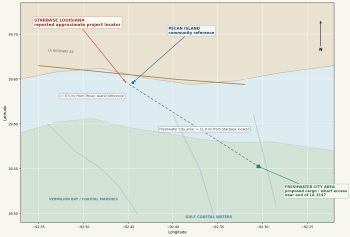
Map shows the distance between Starbase Louisiana and Pecan Island.
Roughly six miles south of the proposed Starbase Louisiana sits Pecan Island – a sacred spot of duck hunting since the 1940s, unless of course you want to take a deep dive back to the 1760s when the French-speaking Acadians (ancestors of the Cajuns) found it as a sanctuary (along with other parts of Louisiana) after being expelled from the Canadian Maritime provinces by the British. It’s probably a good guess that those new arrivals hunted the migratory waterfowl of the abundant flyway.
Generations later, the character and livelihood of Pecan Island’s Cajun community are symbiotic with the surrounding coastal marshes, undoubtedly to be battered by up to 30 rocket launches per day, as Shotwell predicted.
But no worries. As she said at the press conference “Now the birds might fly away during a launch, but I guarantee they’ll come back. And they come back right away, by the way. As soon as the rockets gone, the birds come back. It’s not like months later.” (Sounds like Shotwell actually has Neoprene waders tucked in among her linen business suits and full-grain leather high heels.)
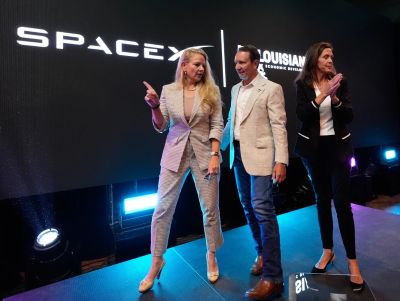
SpaceX President and COO Gwynne Shotwell, left, speaks with Louisiana Gov. Jeff Landry, center, and Sec. of Louisiana Economic Development Susan Bonnett Bourgeois at the event announcing Starbase Louisiana, on Aug. 25, 2026, in Abbeville, Louisiana (photo: Associated Press).
Shotwell’s assurances are rooted in the experience of the migrating shorebird behavior roosting near SpaceX’s Texas sites in Boca Chica and Brownsville. But the migrating shore birds and their habitats around those sites may not react in the same way to the levels of stress in the Mississippi Flyway. Bottom line: there is no hard research yet to support her assertion when it comes to the migrating waterfowl around Starbase Louisiana. But in looking for clues about the fate of Pecan Island, the news is not great for the shorebirds around those SpaceX Texas locations.
A June 2024 report by the Coastal Bend & Bays Estuaries Program (https://www.cbbep.org) of Corpus Christi, Texas following a fourth consecutive SpaceX launch, documented damage to eggs in nine shorebird nests that were approximately 1,000 feet from the site. The study concluded that the nests were probably impacted by flying debris from the rockets. Researchers will tell you that migrating shorebirds don’t just need a place to land, but to recover, which includes raising their young.
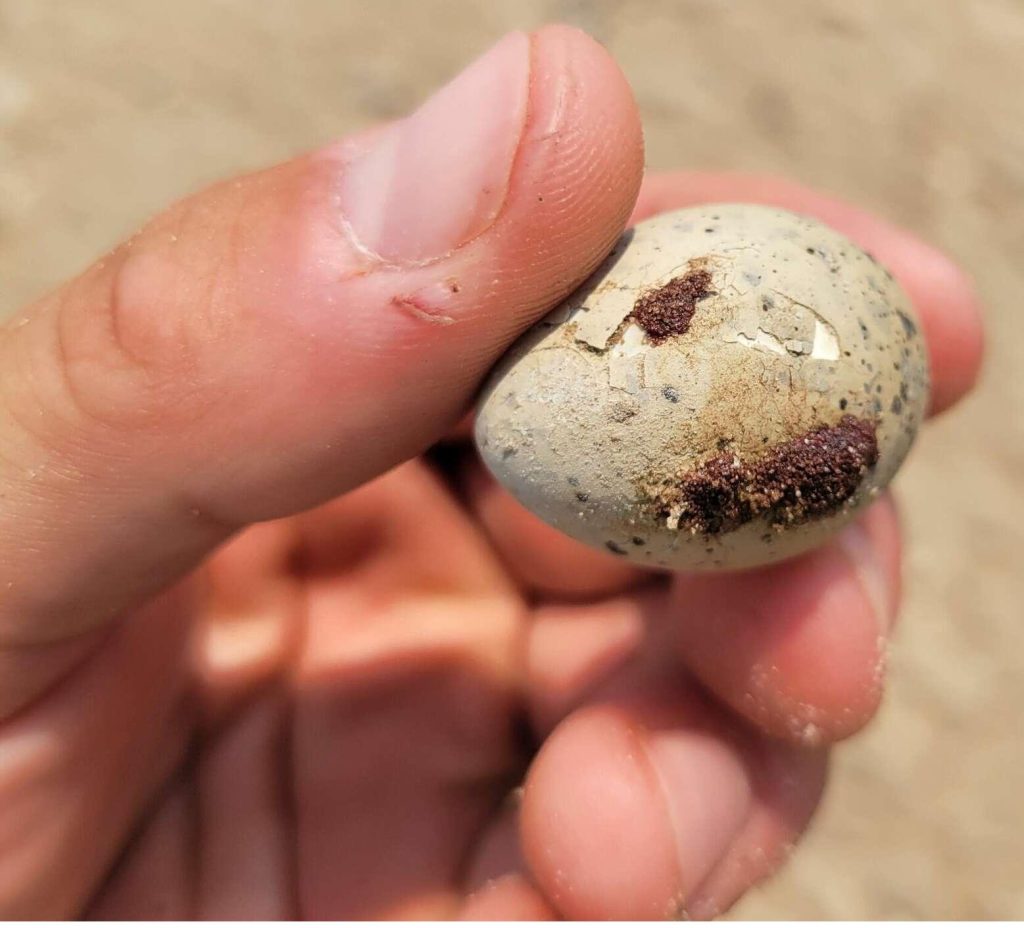
In Boca Chica, Texas, a shorebird egg damaged from SpaceX rocket-launch debris (photo: CBBEP).
Damaged eggs alone won’t inevitably drive the birds to other locations. The problem, though, is that repeated nest failures around launch platforms could lower reproductive rates even if the birds continue to return.
Despite Shotwell’s public assurances, Pecan Island is, in effect, ground zero in the preservation of an iconic American hunting grounds for ducks, snow geese and other game birds against a tsunami of corporate money and political steamrolling. In Southwest Louisiana, Pecan Island lies near Rockefeller Wildlife Refuge and other coastal wetlands along a flyway that provides seasonal feeding, resting and wintering habitat for waterfowl migrating across the Gulf of Mexico south from Canada.
In the wake of the press conference, Louisiana conservationists and waterfowl hunters now await their fate of how the massive SpaceX development will impact their culture and livelihoods.
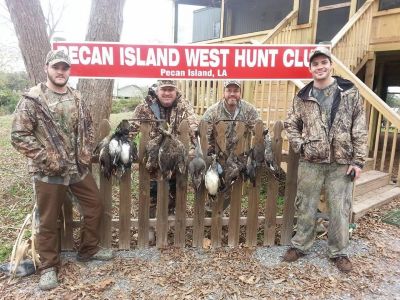
Hunters from the Pecan Island West Hunt Club (photo https://piwesthunting.com)
The SpaceX $100-billion rocket complex casts a long shadow over Pecan Island. Nearby rocket blasts, searing exhaust heat and related chemical and particles, blinding light and general launch commotion will likely cause birds to flush or find other places to feed and rest during the migration.
The wetlands around Pecan Island are an imperative for the wintering birds. Pecan Island is a destination. It is here where exhausted birds prepare for the next stage of a journey that can stretch thousands of miles. If SpaceX breaks Pecan Island, the flyway breaks with it. Case in point: 40 percent of all North American waterfowl use the Mississippi Flyway each year.
As of October 2026, the SpaceX project is still in its planning and design phases, so the full ecological effects remain theoretical. Even if conservationists, ornithologists and lawyers make a convincing case to regulators and judges, there’s still a gotcha.
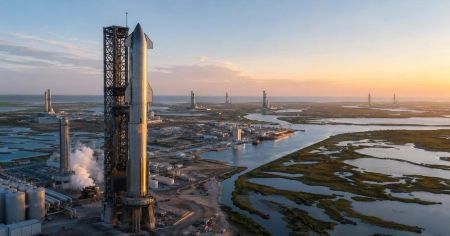
Official SpaceX concept rendering of Starbase Louisiana (photo: SpaceX).
SpaceX says that exclusion zones could extend three to five miles from launch sites. At 30 launches daily, hunters could effectively be shut out from any access to generational blinds, hunting leases and prized boat routes even if they make their case in court. Starbase Louisiana proves that a wetland hunting habitat can indeed remain intact and even legally defensible while also becoming inaccessible.
Activists have revealed that state permit applications are already filed for some 400 acres of marsh loss from Starbase Louisiana. The massive construction project may require wetland dredging and drainage revisions to provide SpaceX with deep-water maritime access for rocket barges and other boats through the Intracoastal Waterway, in addition to construction of an airport.
SpaceX counters that it will generously apportion tracts of its property as natural habitat. But skeptics will ask: will those areas still be accessible during launches? Will they be suitable for hunting and fishing? What about chemical and particulate fallout from the rockets and their impact on the environment and wildlife? And what about any other anti-hunting restrictions that SpaceX can enact at a whim?
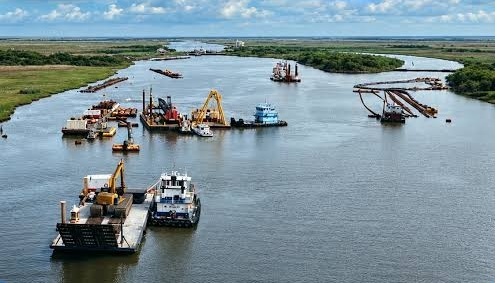
Dredging operations near SpaceX Starbase Louisiana on the Freshwater Bayou Canal in Vermilion Parish, Louisiana (photo: LouisianaCyberTruck)
Musk has big government behind him. So far, the Federal Aviation Administration has proposed waiving 13 federal environmental and safety laws for commercial space licenses – including the Endangered Species Act.
Their filings follow President Trump’s August 2025 executive order, “Enabling Competition in the Commercial Space Industry,” which directs Washington to expediate growth of America’s space industry.
Overall, the FAA’s 13 waivers argue that environmental reviews can create significant inter-agency delays for companies like SpaceX. The FAA wants to gut requirements it considers unnecessary that, in effect, could protect the Mississippi Flyway.
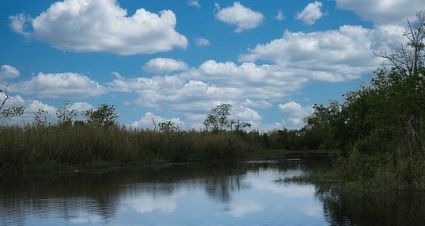
Pecan Island (photo: https://louisianadestinations.com)
On October 26, 2026, the Louisiana Wildlife Federation (https://lawildlifefed.org) issued a statement urging the FAA and the U.S. Department of Transportation to adopt site criteria for Starbase Louisiana that assesses wildlife and habitat durability, public access and coastal hazards with the long-term view of whether or not the flyway can absorb repeated launch operations over decades.
Meanwhile, since the announcement of the SpaceX Starbase facility in Vermilion Parish, Delta Waterfowl policy staff has had a number of conversations with Louisiana Department of Wildlife and Fisheries (LDWF) staff and leadership to offer our assistance and provide feedback from our members and duck hunters in the region. LDWF is the agency entrusted with stewarding Louisiana’s natural resources, and Delta Waterfowl wants to make sure their equities are taken care of for any real or felt impacts of a project this large in such a special area. Delta Waterfowl is a leading nonprofit conservation organization dedicated to conserving waterfowl and promoting waterfowl hunting through scientific research, habitat conservation, duck production programs, and hunter education (https://deltawaterfowl.org).
“With southwest Louisiana being such a critical area for wintering waterfowl, and equally as important for waterfowl hunters, we want to make sure any loss of public hunting opportunity or impacted access is addressed and worked out between SpaceX and LDWF, and that ducks and duck hunters are part of the conversation as this project moves forward,” said Cyrus Hunter Baird, Delta Waterfowl’s Vice President of Government Affairs.

Cyrus Hunter Baird, Delta Waterfowl’s Vice President of Government Affairs (photo: Delta Waterfowl)
But let’s face it, people in Louisiana need jobs. SpaceX’s proposed Starbase Louisiana is expected to create 3,000 direct jobs over 10 years, with an average annual salary of $92,600, according to Louisiana Economic Development agency. The state estimates an additional 8,100 indirect jobs through construction and other services. That economic boon needs to be placed within the context of the state’s household income and poverty levels that are consistently ranked among the absolute lowest in the country.
Naturally, the public reaction to Starbase Louisiana is polarized. Enthusiasm runs high with business leaders, labor and economic development professionals. Opposed are groups of residents and conservationists that want to preserve Pecan Island’s wetlands, waterfowl and a way of life that can be traced to the mid-1700s.
PecanIsland.space (https://pecanisland.space) is a local social-media aggregator that compiles ongoing developments about Starbase Louisiana impacting the community.
As the site’s admin says “I’m a Louisiana resident who grew up in the Acadiana area, and I love this state just as much as you do. I’m not here to sell you a side – I’m here to make sure we all know what’s happening in our own backyard.”
Another local organization called “Stop SpaceX” (https://stopspacex.com) has a mandate of saving Pecan Island and the Mississippi Flyway. The group will tell you “Waterfowl are not adaptable in the way we might hope. They return to the same marshes, the same feeding grounds, the same roost sites year after year. Displace them once and many will not find suitable alternatives. Displace them repeatedly and populations collapse.”
Their motto is “Paradise is not a launchpad.”
Irwin Greenstein is the Publisher of Shotgun Life. You can reach him at the Shotgun Life Facebook page at https://www.facebook.com/shotgunlife#
Irwin Greenstein is Publisher of Shotgun Life. Please send your comments to letters@shotgunlife.com.

Comments