
Chenier Shotshells: Louisiana Roots, Family Values and a Load Built for Ducks
In the duck blinds of southwest Louisiana, where marshes, swamps and rice fields define the landscape, a shotgun shell has to prove itself the old-fashioned way: in the field.
For Damon Herbert, owner of Chenier Shotshells, that means developing ammunition with a hunter’s priorities in mind. Pellet count matters. Performance matters. Price matters, too. And no amount of advertising can substitute for a load that consistently does the job when ducks are working the decoys.
Damon launched his ownership of Chenier in December 2025, taking over a business founded several years earlier by his friend, Brent Hoffpauir. Since then, he has continued building the brand around a straightforward proposition: premium waterfowl ammunition, developed through testing and hunting experience, at a price intended to remain within reach of everyday hunters.
It is a small operation, but one with deep roots in the Cajun Prairie and a distinctly family-run approach to making shells.
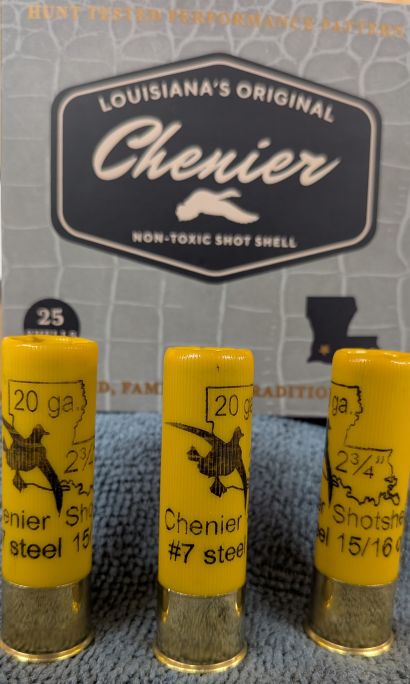
Chenier shotshells in 20 gauge.
A Hunter Raised on the Cajun Prairie
Damon grew up in south-central Louisiana, in the communities of Welsh and Hathaway. Hunting was part of his upbringing, although duck hunting did not become a regular pursuit until he was about 12 or 13.
He and his brother, Shawn, hunted together, sometimes joined by their father when work allowed. Damon’s introduction to shotguns followed a familiar progression for a young Louisiana hunter. He started with an H&R Topper single-shot, moved to his father’s Stevens side-by-side at around 14, and eventually saved enough money to buy a Remington 870 when he was 17.
He was working full-time on a farm where he also hunted ducks, giving him an early education in the connection between hard work and time spent outdoors. Dove and goose hunting were also part of the annual routine.
The ammunition available to him back then was largely whatever he could find. Winchester Super-X was considered good stuff, as was Federal ammunition. Damon still has some of those older shells as keepsakes.
Those experiences helped shape the practical outlook he brings to Chenier today. Ammunition isn’t an abstract exercise in ballistics for someone who hunts with the products he makes. It is equipment that must perform under real hunting conditions.
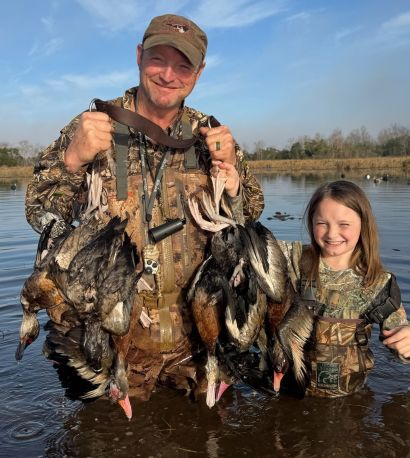
Chenier Shotshell owner Damon Herbert duck hunting with daughter, Savannah.
From the Oil Fields to the Loading Bench
Damon entered the oil and gas industry around 1997 or 1998, working as a production operator responsible for keeping operations running and oil flowing. His career has included offshore work in the South, and he now works in New Mexico.
The energy business and shotshell manufacturing may seem like different worlds, but both demand attention to process, consistency and the details that can make a difference in the final result.
Damon had been loading shells for his own use for years before Chenier became a business opportunity. The turning point came when Hoffpauir, who had started Chenier around 2019 or 2020, offered to sell him the company after a friend had purchased some of its ammunition. Damon took over in December 2025.
The company had been loading straight-bismuth ammunition, but the high cost of bismuth prompted a shift toward steel loads. That change reflected a practical consideration familiar to waterfowlers: the desire for effective ammunition without making every trip to the blind prohibitively expensive.
For Damon, the challenge is to develop loads that satisfy his standards while keeping the retail price reasonable. Chenier’s shells, according to his notes, range from approximately $25 to $30, positioning the brand below some of the larger manufacturers while pursuing a premium-ammunition identity.
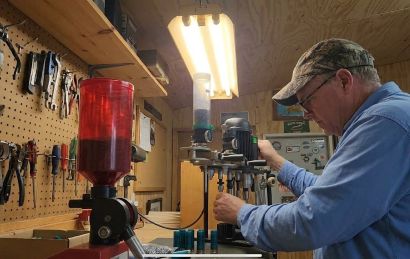
Chenier hand-loads of 16 gauge, 1 ounce #6s.
Developing a Load, One Test at a Time
Chenier’s approach to load development combines available technical data, professional testing and field experience.
Damon begins by studying existing data and working with components such as Cheddite hulls and different powders. Rather than relying exclusively on his own equipment, he sends most of his shells to Precision Reloading for testing.
The process typically takes about two weeks. The shells are evaluated for pressure and velocity, after which Herbert reviews the results and makes adjustments. He then sends the revised loads back for another round of testing as needed.
In manufacturing the shells, he follows the industry standards of the Sporting Arms and Ammunition Manufacturers’ Institute (SAAMI).
But laboratory results are only part of the process. Damon also tests patterns on paper before taking the ammunition into the field. There, he evaluates how the loads perform in actual hunting situations, making minor adjustments until they deliver the results he wants.
It is a deliberately practical approach. A load must meet the technical requirements, but it also has to earn its place in the duck blind.
Chenier describes its development philosophy as old-school testing under demanding conditions, using modern firearms and aftermarket choke tubes in real hunting situations. The company says its early product development grew out of conversations and experimentation among friends who wanted to create better handmade waterfowl ammunition.
Rather than relying on a formal pro-staff program for Chenier, Damon works with a group of people who have been involved since the beginning, helping develop and test the products.
That emphasis on hands-on evaluation fits Herbert’s own hunting background: test the ammunition, take it hunting, and see what happens when the conditions are real.
Irwin Greenstein is the Publisher of Shotgun Life. You can reach him on the Shotgun Life Facebook page at https://www.facebook.com/shotgunlife#
Valuable resources:
The Chenier Shotshells web site

Irwin Greenstein is Publisher of Shotgun Life. Please send your comments to letters@shotgunlife.com.

Comments