
Payloads, Shot Size & Pellet Count: The Three Variables That Determine How Well a Shotgun Load Performs
When choosing shotgun ammunition, it is easy to get distracted by the latest materials, exotic pellet compositions and impressive claims on the box. But effective shotshell performance ultimately comes down to a combination of load, shot size, pellet count and choke, and how those elements work together at the distance you intend to shoot.
One of the most important lessons for the wing and clay shooter is that a premium pellet material does not automatically make a load better. What matters is whether the complete payload delivers enough pellets to the target while providing the performance needed at the distance involved.
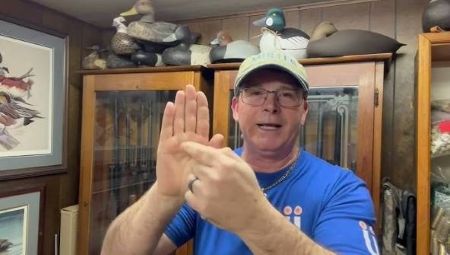
Jimmy Muller
Don’t Be Seduced by the Pellet Material
Consider the growing popularity of TSS, or tungsten super shot. TSS has become a premium component because of its performance at extended ranges. But simply seeing “TSS” on a shotshell box doesn’t necessarily mean that the load is going to provide a meaningful advantage.
A load can contain a relatively small number of TSS pellets mixed with steel, bismuth, lead or another shot material. The presence of a few TSS pellets may sound impressive, but those pellets still have to contribute meaningfully to the payload.
In other words, don’t buy the label, evaluate the load.
Adding a small amount of an expensive pellet material can substantially increase the price of a shotshell without necessarily giving the shooter the performance expected from a dedicated TSS load. The important question isn’t simply “Does this shell contain TSS?” The question is “How much TSS is actually in the payload, and what is the load designed to accomplish?”
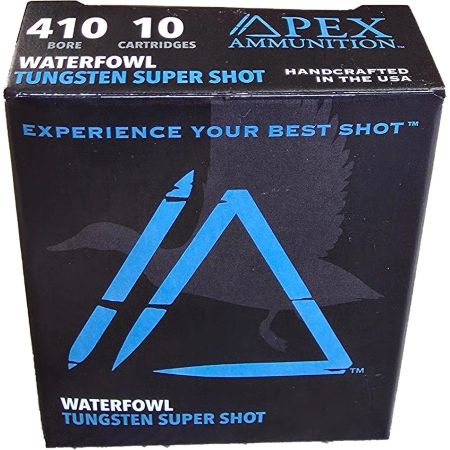
Tungsten shotgun shells.
Distance Changes the Equation
The farther a bird is from the muzzle, the more demanding the shot becomes.
For shooting around 50 yards, bismuth can provide very good performance when the load, shot size, choke and shooting technique are properly matched. Steel can also perform adequately with the right combination of components and choke.
But beyond approximately 50 yards, TSS becomes increasingly attractive because of the additional energy it can provide at extended range.
That doesn’t mean bismuth suddenly stops working at 50 yards. Experienced shooters can and do take birds at 60 yards with bismuth. But at these distances, there is considerably less room for error. The load has to be right, the shot size has to be right, the pellet count has to be appropriate, and the choke has to produce the necessary pattern. And, perhaps most importantly, the shooter has to put the pattern in the right place.
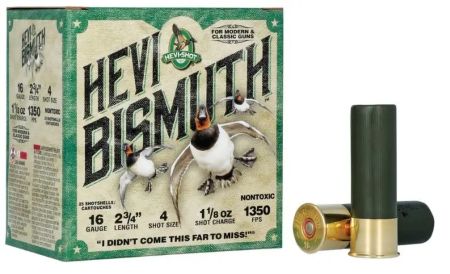
Bismuth waterfowl hunting loads.
Payload Is More Than a Number
When comparing shotshells, shooters often concentrate on pellet material or shot size. Pellet count deserves equal attention.
A high-performance pellet can deliver impressive energy, but you need enough pellets in the payload to put sufficient pellets on the target.
This becomes particularly important with TSS. Because TSS provides substantial energy, it can be tempting to assume that fewer pellets automatically produce an effective load. But reducing the number of pellets also reduces the number of opportunities for a pellet to reach the target.
That brings us to one of the most important concepts in selecting a long-range load: margin of error.
The shooter isn’t trying to put one perfect pellet into one perfect spot. The goal is to create a payload and pattern that provide enough opportunities for effective hits when the shot isn’t absolutely perfect.

It’s important to be selective about payload composition for long shots.
The Right Combination
Think of shotshell performance as a system rather than a single specification.
The critical variables include:
- Load: The complete shotshell configuration.
- Shot material: Lead, steel, bismuth, TSS or combinations of materials.
- Shot size: The size of the individual pellets.
- Pellet count: The number of pellets available to form the pattern.
- Choke: The choke’s contribution to the resulting pattern.
- Distance: The range at which the shot will actually be taken.
- Shot placement: Where the pattern intersects the bird.
Change one of these variables and you can change the performance of the entire system.
For example, a load containing a high-energy pellet doesn’t automatically compensate for an inadequate pellet count. Likewise, having a large number of pellets doesn’t guarantee success if the load, choke and shot size aren’t appropriate for the distance.
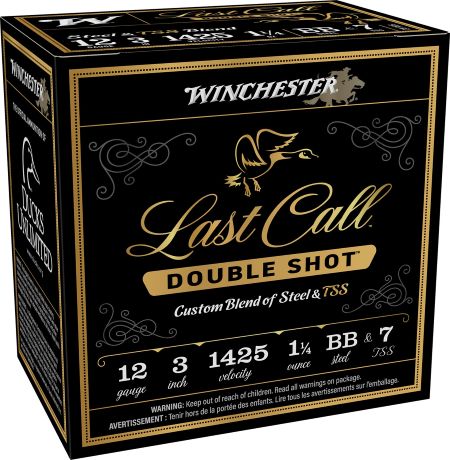
Winchester’s version of a TSS/steel blend load.
Pattern Testing Is Essential
The only way to know what a particular combination is doing is to test it.
One useful approach is to shoot patterning cards at the distances where you expect to hunt. A 50-yard pattern can reveal whether your chosen load is delivering the pellet distribution you need.
The objective isn’t merely to discover whether the gun “patterns.” You want to understand what the entire payload is doing at the distance where the shot matters.
This is especially important when using specialized loads. A load that performs beautifully at one distance may produce a very different result farther out.
Due to the fact the paper is only one dimensional (two dimensional if you take in consideration the raised paper on the back of the paper where the pellet punches through) and therefore does not tell you shot-string length or show you a three-dimensional image of the shot pattern for efficiency, it is very important to also shoot an object on the water at the distance you intend to use the shotshell/choke combination for a full understanding of what the shotstring and efficiency is. What do I mean by efficiency in shot string?
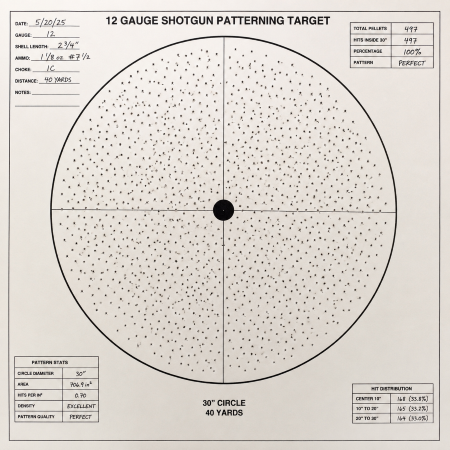
A 12-gauge shotgun pattern on a paper target.
On paper, the only thing you know is every pallet and the shotshells going to go through the paper. However, you do not know how or when they all got there. If you have a bird in the air the length of the shot string is not very significant. But if you have a bird on a horizontal surface like water, while hunting for example a cripple or a water swat, if you have a long shot string the pellets are going to be strung out for a very long distance and you’ll be very lucky to even hit the bird with a couple pellets. But if the shot string is short, it’s like dropping a pancake on the bird and it’s like an explosion on the water, this is what makes a pattern efficient. And for a target in the air, a short shot string versus long you are also going to put more pellets on the target. I have proven this through hundreds of thousands of rounds on targets and live birds, on paper and on water.
The Margin of Error
At extended range, accuracy becomes increasingly important.
With TSS, the additional energy available at distance can provide a significant advantage. But that advantage doesn’t eliminate the need for an effective pattern. If the payload doesn’t contain enough pellets – or if those pellets aren’t distributed effectively – the shooter’s margin for error becomes smaller.
In practical terms, a shooter using a high-performance load still needs to make an accurate shot.
The ideal combination is, therefore, not simply the most powerful pellet or the largest payload. It is the combination that gives you the necessary pellet performance and enough pellets in the pattern to provide a reasonable margin for error.
This is very important and nobody talks about or teaches it. For clay targets and duck-size game, we only need and want 100 pellet density in a 30-inch circle area to give a good consistent break or ethical kill.
Anything less than that is not reliable on a clay or ethical on game and anything more than that is an overkill, not needed or wanted, and this is why: if you only have 100 pellets in the shotshell, you need them all inside a 30 inch circle as mentioned. By comparison, if you have more than 100 pellets (300 pellets for example), that means you want 200 pellets outside the 30 inch circle, spread out as evenly as possible to give you the same type of spacing that you would get with the 100 pellets that are in the 30 inch circle. This will give you the largest margin of error and the same reliable break on a target and same ethical kill on a game bird as the hundred pellets in a 30 in circle.
This is why patterning on paper is a good thing to be able to give you that pattern size and Pellet count.
Don’t Let Marketing Choose Your Ammunition
The lesson is simple: don’t choose a shotshell solely because the box features an exotic pellet material.
Look at the complete load.
Ask yourself:
- What is the shot material?
- What is the shot size?
- How many pellets are in the payload?
- What choke are you using?
- At what distance are you going to shoot?
- What does the pattern actually look like at that distance?
Those questions are far more useful than simply asking whether a shell contains TSS.
For shots at moderate distances, a properly selected bismuth or steel load may provide all the performance required. As distance increases, TSS can become increasingly advantageous. But regardless of pellet material, success still depends on matching the load, shot size, pellet count and choke to the intended distance – and putting the pattern where it needs to go.
The best shotshell isn’t necessarily the one with the most exotic ingredients. It’s the one whose complete payload gives you the performance and margin of error you need for the shot you’re actually going to take.
Jimmy Muller is Inventor and Founder of Muller Chokes. He is an NSCA Master Class shooter and FITASC, Sporting Clay and 5-Stand Competitor. In addition, he is a Master Wingshooter, Master Tool Maker, Aerospace/Defense Manufacturer, Metallurgist, Mechanical Engineer and a Master in Heat Treatment of metals.
Muller Chokes manufactures each of its space-age chokes to the specific bore specifications of individual shotguns. Virtually every other choke maker delivers the same constrictions regardless of the shotgun. Muller Chokes owns patent #8,7452,324 for gun-specific shotgun patterns that match the internal bores of the gun maker’s specifications. Muller Chokes are made of Aerospace/Ballistic Aluminum. Improve your wing and clays performance with Muller Chokes. Find out more at https://mullerchokes.com
Jimmy Muller is Inventor and Founder of Muller Chokes. NSCA Master Class shooterFITASC, Sporting Clay and 5-Stand Competitor. Find out more about the extraordinary Muller Chokes at www.mullerchokes.com

Comments