
The Resurgence of England’s Frederick Beesley as a Maker of Modern Luxury Shotguns
When it comes to reviving the names of long-gone British gunmakers, entrepreneurs face two choices: the easy way or the Tom Ward way.
The easy way is to buy the rights to an extinct marque and laser-engrave its name on a Turkish sporting gun. Case in point: Webley & Scott, William Powell, E.J. Churchill, Cogswell & Harrison and Holloway & Naughton.
But you’ll discover after spending 40 minutes with Tom that the easy way won’t produce a great sporting gun that also pays tribute to the English legends. It took a few years of experimentation and research, but as Director of the London Gun Company, Tom was able to probe a deep well of resources before resurrecting the U.K’s Frederick Beesley with a stable superb, high-performance over/unders.
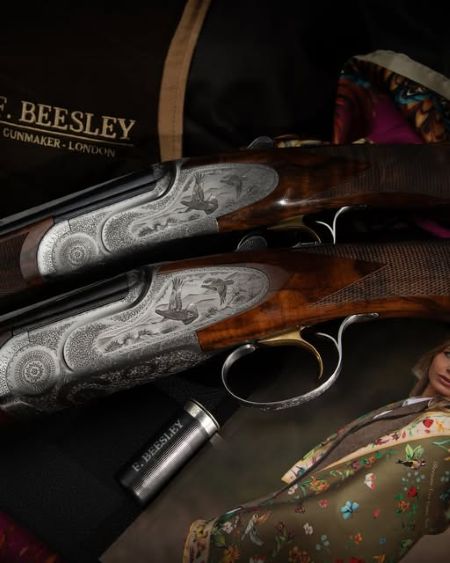
“I always wanted to build my own guns,” Tom said, “and I heard through the grapevine that Beesley was for sale. It was appealing because Beesley was an inventor and a innovator. So we’re starting again with that beautiful Beesley name.”
While not as widely recognized as Purdey, Boss, Holland & Holland or Westley Richards, gunmaker Fredrick Beesley cemented his own legacy in the annals of U.K. gunmaking by patenting a self-opening sidelock action. Purdey bought the rights to it, and Beesley’s invention became the basis for the renown Purdey self-opening shotgun that’s regarded as one of the finest break-open innovations.
F. Beesley was founded in 1879, specializing in high-grade bespoke sporting guns, often featuring sidelock ejector designs. Through a total production of approximately1,800 guns, Beesley filed some 25 patents mostly related to self-opening mechanisms.
The company remained active through the 1920s. Then in 1927, Frederick’s son Herbert took over and ran it until 1939, overseeing a limited run.
After World War II, a few more Beesley guns were made until 2018. The Frederick Beesley name subsequently came under the ownership of the Harris & Sheldon Group.
In 1987, the rights to trade as Frederick Beesley were bought by businessman Fred Buller. The firm was restyled as Frederick Beesley Gunmakers. A small number of handmade shotguns were sold, including the eye-catching Jurassic with its prehistoric-themed engraving.
Then in 2014, Tom and his father Gary, founders of the London Gun Company, bought Frederick Beesley Gunmakers. In addition to the name, the sale included patent designs, original ledgers and other assets that Tom described as “a beautiful history of Beesley. When we bought the name, we had no idea at the time of what the gun would be.”
The Wards’ advantage of owning the London Gun Company provided a wealth of market research to ensure a successful Beesley renaissance.
“We listened to our clients,” Tom explained. “Instead of doing something we wanted to design, we asked our clients ‘What would you like?’ Traditional guns are going away. The high-net- worth guys wanted something that works. They were tired of gun failures.”
The comprehensive client survey touched all aspects of the company’s services that could be applied to designing the Beesley. Tom had access to the buying trends from the London Gun Company’s gunsmithing, gun sales, storage, appraisals, import/export, gun rentals, and concierge services for British and international hunts.
Miles Oreford, Sporting Operations and Logistics Manager, elaborated on how the concierge services would apply to a culture of a bespoke Beesley. Through Miles, clients can book bird hunts, deer stalking, simulated clays and driven boar. “We book 50 to 80 hunts per year,” he said. “We make sure they’re hassle-free trips.”
Tom was able to touch upon all of those real-world elements in developing Beesley as a luxury brand. He also tapped into his own expertise in the field, participating in some 100 shoots per year.
Their clients’ responses yielded four criteria: 1) reliability, 2) over/unders, 3) high performance to handle powerful cartridges for days of shooting 500 very high birds, and 4) a low priority for aesthetics.
“Plain guns were very popular,” Tom added. “People in the U.K. were not seeing as much value in aesthetics as people in the U.S.”
Once that information had been synthesized, Tom reached a point “we had to ask ourselves, ‘How do we build the gun?’ I spent about a year looking into the U.K. We would’ve needed at least four fulltime employees and four years before we could make our first gun. That wasn’t viable. It would have been a good passion project, but not a good business.”
The London Gun Company had frequently brought Tom to Italy around the town of Gardone Val Trompia in Brescia – the heart of Italian gunmaking. “I had a lot of experience with the Italian quality. I met with Italian craftsmen. I told them I needed to build a business that could produce 50 to 100 guns per year.”
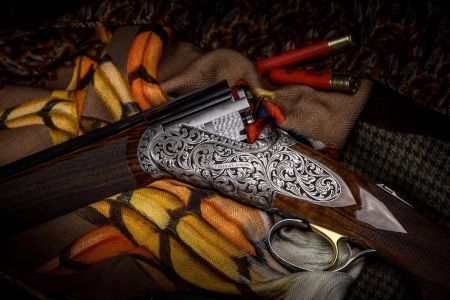
He wanted the Beesleys to be high-grade, bespoke field guns. Tom initially struck a deal with fine Italian gunmaker to private-label the Beesleys, but realized there was indeed a better way.
The region has an amazing network of craftsmen in the gun trade. Think Fabbri, Beretta, Fausti, FAIR, Bosis, Poli, Perugini & Visini, Famars, Rizzini and Zoli. Likewise with engravers such as Fracassi, Pedretti, Bottega Giovanelli, Lorenzo Gamba and Dassa.
A cottage industry of specialists including action makers, barrel makers, stockers and finishers could easily support the guild-like model of gun building that originated in Germany during the 18th century and eventually spread to the U.K. In Brescia, Tom had ready access to the most talented experts. It would be a modern twist on the British guild gun during the heyday of Birmingham and London gunmaking.
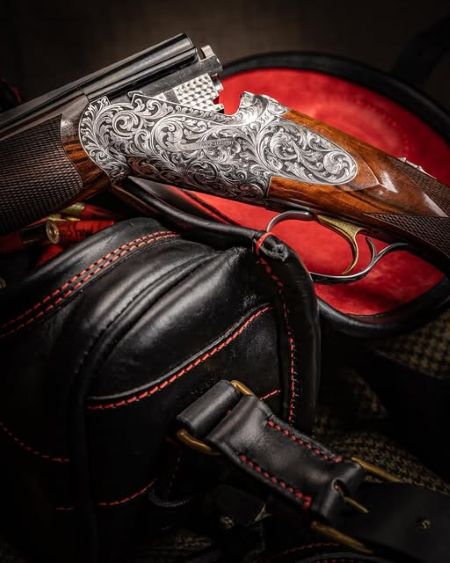
“We tapped into the best of everyone in Italy,” Tom said. “The customer’s order dictates who we work with. From order to receipt, it takes about 12 months.”
Beesley introduced their first shotguns, the Fenice and Eleganza, in 2018. Currently, Beesley offers four single-trigger over/unders.
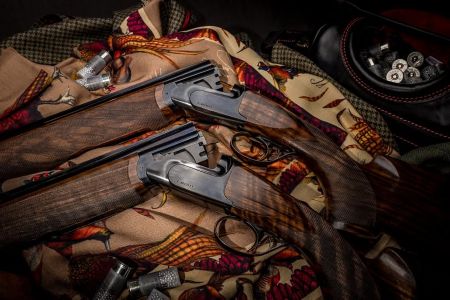
Beesley describes their boxlock Tecnica as “the purest expression of the F. Beesley brand.” The Tecnia addresses their customers’ requirements for a plain and reliable shotgun, as the Tecnica handles killing power through three-inch chambers, steel-shot proofing and mechanical triggers. For those soggy days, the Tecnica is finished with the Diamond Like Carbon technology, which they describe as the “hardest coating ever to be used on shotguns. It provides an exceptional finish, while giving unparalleled protection from the elements, whilst also self-lubricating.” The Tecnia’s sleek unadorned black action projects forward-looking minimalism. It can be ordered in all popular gauges.
A variation on the Technica is the Beesley Ultra. The company calls it “the ultimate high bird gun” able to withstand volleys of heavy loads using a denser action while reducing felt recoil through fine-tuned balance and heft. It’s only available in 12 gauge. Naturally, it’s finished with Diamond Like Carbon.
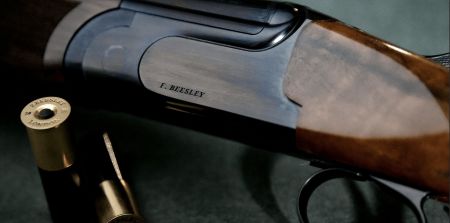
Next up is the Fenice. It’s a high-grade, steel-proofed over-and-under game gun designed in the spirit of London gunmaking. The Fenice’s removable mechanical-trigger-plate action enables a low profile for quick shooter responses through a clear sight picture, ideal balance and nimble handling. In terms of appearance, the standard choices are a black action or the house-engraved rose and scroll. All popular gauges can be ordered. Barrel lengths vary between 24 and 30 inches with either multi-chokes or fixed constrictions.
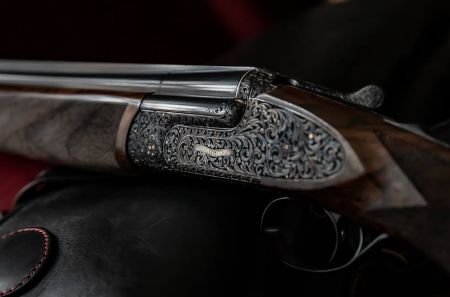
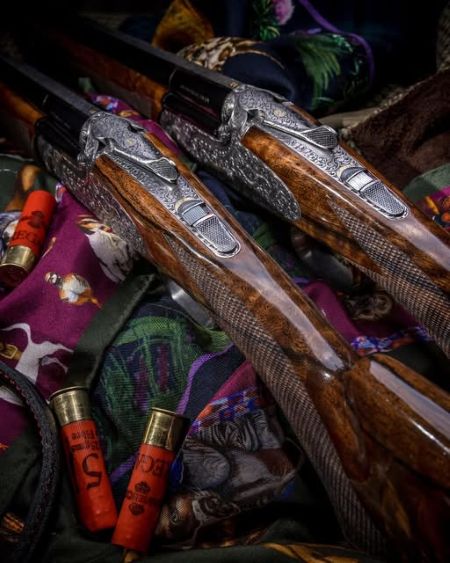
The Eleganza marks the pinnacle of Beesley’s gun craft. The game gun takes about 1,000 man hours before it can fully meet the client’s detailed preferences and measurements (and the owner is invited to Italy to inspect it during production). Beesley describes the Eleganza as “completely bespoke” with leaf or coil springs, any grade Turkish walnut and profuse engraving intended to evoke the original Shotover models of the 1920s.
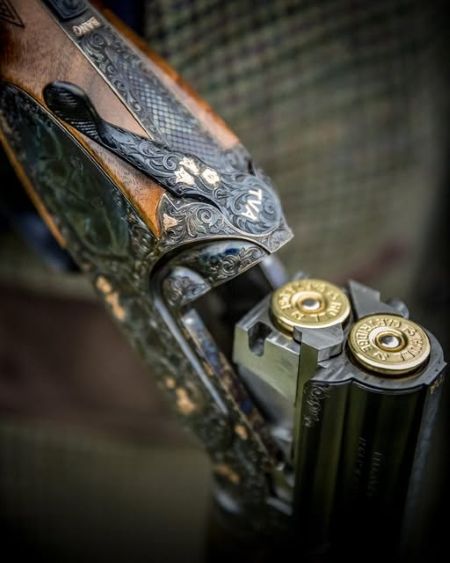
Now Tom and his team are bringing the Beesley resurgence to the U.S. In May 2025, the company appointed lan Harrison as Vice President of North American Sales. An Englishman who emigrated to the United States 37 years ago, Ian established his reputation in luxury sporting gun sales as Director of Beretta’s Premium Guns division in the U.S, he oversaw sales for the prestigious Beretta Gallery, and helped design some of Beretta’s celebrated bespoke firearms
At Beesley, lan applies his experience in the design and sales of luxury shotguns – including collaborations at Beretta such as the Rocky Gun for Sylvester Stallone, the Dante Gun, the Homage to Italy pair, and the singular IZUMI Shotgun.
In talking with Ian, he told me, “I’m excited that I could work with a British brand. I feel more American than British, and I understand the American upland hunter. It’s great to be working with an old British brand being rebuilt by young British men. Together, we can absolutely bring the client whatever they want in fine shotguns.”
Irwin Greenstein is the publisher of Shotgun Life. You can reach him on the Shotgun Life Facebook page at https://www.facebook.com/igreenstein1/
Important resources:
The Frederick Beesley web site
The London Gun Company web site

Irwin Greenstein is Publisher of Shotgun Life. Please send your comments to letters@shotgunlife.com.

Comments