
An American Matched Pair: Ernest Hemingway and his Winchester Model 21 Side by Sides
Writer Ernest Hemingway revolutionized modern literature through his distinctive American minimalist style, which has profoundly shaped how writers approach prose even today. Likewise, the legendary Winchester Model 21 side by side emphasized simplicity and strength in an understated design that, in effect, mirrored Hemingway’s own writing style in steel and wood.
Peel away Hemingway’s subconscious and the question arises: was he infatuated with the Winchester Model 21 because he saw it as a symbol of himself?
American hunters would come to appreciate the svelte lines, structural integrity and masculine prowess of the new Model 21 as the same traits that drew readers to Hemingway’s fiction and journalism: authority through restraint.
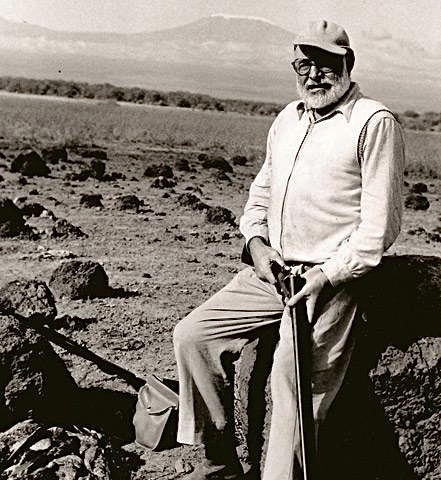
Ernest Hemingway wingshooting in Africa (photo: John F. Kennedy Library).
Both Hemingway and the Model 21 represented departures from the centuries of European overindulgence in written story telling and the craftsmanship of England’s Golden Age of gunmaking that bridged the Victorian and Edwardian eras. The flourishes and convolutions of both old-world disciplines fell under the axe of Hemingway and his beloved Model 21 shotguns as America seized the reins of streamlined modernism during the late 19th to mid-20th century.
By time Winchester introduced the standard grade Model 21 in 1931, Hemingway had already become a star with his groundbreaking novels “The Sun Also Rises”(1926) and “A Farewell to Arms” (1929). Reviews at the time characterized the novels as honest and even well-written but morally vacuous. America had yet to realize Hemingway’s literary architecture of lean, precise prose that would allow readers to interpret the intended underlying virtue of the characters without the romantic overkill that he set out to destroy.
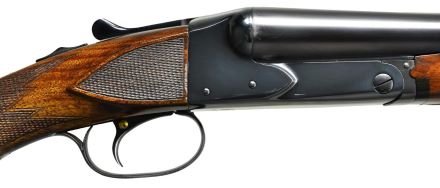
The Winchester Model 21 in Skeet Grade.
You could say that Hemingway’s oft-misunderstood reception was similar to the introduction of the Model 21. When Americans caught their first glimpse of the staid and sturdy shotgun, the reaction was less than flattering as comparisons were drawn to more prestigious British shotguns. The Model 21’s no-nonsense boxlock action, sturdy frame and steel extruded from war-hardened mills blew up any romantic notions of the aristocratic field gun. The Model 21 was Winchester’s premium shotgun, meticulously built almost entirely by American hands.
The Winchester Model 21 and Hemingway’s prose shared a philosophy of unblinking integrity, structural strength and a plainspoken vernacular. Function first, but with style. Winchester’s gunmakers and the writer prized modesty and poise as bulwarks of a destiny that would endure the whims of fashion.
Whether in the arts or the factory, no one ever said creative austerity came cheap. Hemingway was one of the highest paid writers of the 1930s (and beyond). In the same vein, Winchester’s Model 21 was considered expensive when introduced.
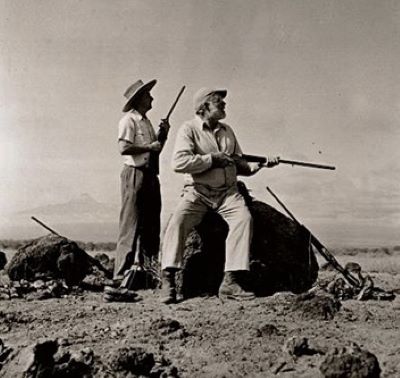
Ernest Hemingway wingshooting in Africa (photo: John F. Kennedy Library).
With the standard grade Model 21 starting at about $60.00, Winchester broadcast the message that the shotgun set a new benchmark for the affluent sportsman. By comparison, a Lefever cost $25.00, an Ithaca $33.00 and an L.C. Smith $35.00. The Model 21 price was excessive even against the premium Parker at $50.00. When it came to putting a price tag on quality, you could say that the Model 21 represented an ideal of American exceptionalism despite the pervasive hardship of the Great Depression. Practically speaking, though, in the right hands, a new $16.00 double-barreled Springfield would certainly fill the pot as would a host of other hardware store guns that a man could buy for $10.00.
Martha Gellhorn’s Winchester Model 21 (photo: “Hemingway’s Guns: The Sporting Arms of Ernest Hemingway” on Amazon at https://tinyurl.com/ytkpsrd2).
The starting price of a Winchester Model 21 was certainly no obstacle for the celebrated Hemingway. He used them frequently in Idaho and Africa. It’s estimated that he owned at least three Winchester Model 21s in 20 gauge documented as Standard Grade with 26-inch barrels tipping the scales at about 6¾ pounds.
Following the success of “For Whom the Bell Tolls,” in 1940 he bought a Model 21 as a birthday present for his third wife, Martha Gellhorn Hemingway and later for his fourth wife, Mary Welsh Hemingway.
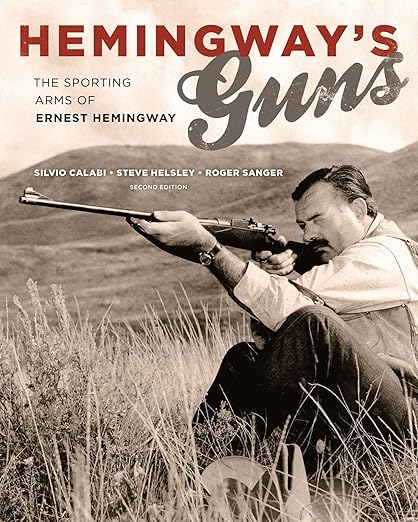
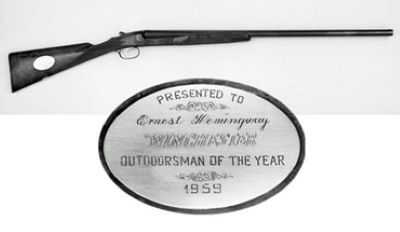
Hemingway was to receive this Model 21 as the Winchester Outdoorsman of the Year in 1959, but died before he could take possession of it ((photo: “Hemingway’s Guns: The Sporting Arms of Ernest Hemingway” on Amazon at https://tinyurl.com/ytkpsrd2).
In 1959, Hemingway was named the Winchester Outdoorsman of the Year and in recognition was set to receive a custom Presentation Grade 12-gauge Model 21, engraved by the company’s master engraver, Nick Kusmit. Due to his failing health and death in July 1961, Hemingway never took possession of it. The shotgun is now displayed at the Cody Firearms Museum.
Some collectors and enthusiasts consider the Winchester Model 21 the pinnacle of the American side by side. And when it comes to writers, Ernest Hemingway is often cited as America’s best. Both are heroes in their own right.
Irwin Greenstein is the publisher of Shotgun Life. You can reach him through the Shotgun Life Facebook page at https://www.facebook.com/shotgunlife#

Irwin Greenstein is Publisher of Shotgun Life. Please send your comments to letters@shotgunlife.com.

Comments